
Profound
Platform · Visibility monitoring · Technical audit · Content optimization
Profile reviewed: Aug 13, 2026
Fit at a glance
- Best for
- Enterprise and multi-brand teams that need visibility, crawler telemetry, shopping, and execution workflows in one platform
- Not ideal for
- Small teams seeking a low-cost single-purpose tracker or independently benchmarked accuracy
Quick facts
- Pricing
- Paid ($99/month (annual billing))
- Type
- Platform
- Declared engine coverage
- ChatGPT, Perplexity, Google AI Overviews, Google AI Mode, Google Gemini, Microsoft Copilot, Grok, DeepSeek, Anthropic Claude
- Company
- Cooper Square Technologies, Inc.
- Headquarters
- New York City, New York, United States
View 6 more profile details
- Company founded
- August 2024
- Domain registered
- May 30, 2024
- Founders
- James Cadwallader, Dylan Babbs
- Editorial classification
- Full-stack AI-search marketing platform; visibility monitoring is the entry point, not the current product boundary
- Date confidence
- Founded August 2024 (vendor-stated); domain registered 30 May 2024 (Verisign RDAP); no exact launch day asserted
- Pricing caveat
- The published entry plan is billed annually; engine coverage, usage limits, and enterprise terms vary by tier
1. What Profound is and where it fits in GEO
Profound is a marketing platform built around how brands appear inside AI-generated answers. Its original wedge was answer-engine visibility: run a controlled prompt set, capture the answers people see, then measure brand mentions, share of voice, sentiment, rank, and citations. Profound’s official product information now positions that measurement layer as the input to a wider operating system for AI-era marketing, rather than as a standalone rank tracker.
The distinction matters when comparing products. A basic GEO monitor tells a team where it appears. Profound also tries to answer what people are asking, which sources influence the answer, whether AI crawlers can reach the site, and which work the team should run next. The vendor’s 2026 product-direction note documents that broader scope. That breadth makes it a platform entry in this directory.
2. Core product areas
| Area | What it does | Decision it supports |
|---|---|---|
| Answer Engine Insights | Tracks mentions, share of voice, sentiment, rank, citations, and competitors across selected engines | Where is the brand visible or absent? |
| Prompt Volumes | Surfaces demand and intent in real AI conversations | Which questions deserve monitoring and content investment? |
| Agent Analytics | Uses crawler, server-log, referral, and conversion data | Are bots reaching the site, and does AI discovery produce business traffic? |
| Shopping | Monitors how products and attributes appear in AI-commerce experiences | Which products win recommendations and how are they represented? |
| Agents and Aim | Prioritizes and executes repeatable marketing work using Profound data | What should the team do next, and what can be automated? |
| Content Optimization | Reviews live URLs or drafts against AI-search visibility patterns | Which page-level changes are worth testing? |
The official platform walkthrough confirms the core monitoring loop: prompt monitoring, answer-engine visibility, citation tracking, competitive benchmarking, and recommendations. The newer product-direction note explains the expansion from analytics into agents and execution.
3. How teams use it
A typical implementation starts with a company, competitors, markets, and a prompt set. Profound runs those prompts on the chosen answer engines and stores the resulting responses. Analysts use the visibility and citation views to find gaps, then connect those gaps to demand, crawler access, content work, or agent workflows. This sequence follows the vendor’s platform walkthrough and should be treated as a vendor-documented workflow.
This creates four linked layers:
- Demand: identify questions and intent worth measuring.
- Observation: capture answer-engine responses and normalize brand and source signals.
- Diagnosis: separate a brand-mention problem from a citation, crawlability, or content problem.
- Action: prioritize optimization or run repeatable work through agents.
Profound says it captures consumer-facing answer experiences rather than treating model APIs as exact substitutes. That is directionally important because API outputs, consumer products, geography, personalization, and timing can differ. It does not eliminate sampling error: teams still need stable prompts, repeated runs, and a documented comparison window.
4. Engine coverage and pricing
The vendor’s product information lists capability across ChatGPT, Perplexity, Google AI Overviews and AI Mode, Gemini, Microsoft Copilot, Grok, DeepSeek, and Claude. Coverage is plan-dependent, not a promise that every customer receives all engines.
As checked on 13 August 2026, the official pricing page lists:
| Plan | Published price | Monitoring boundary called out by the vendor |
|---|---|---|
| Starter | $99/month, billed yearly | ChatGPT tracking, 50 prompts, 100 agent credits |
| Growth | $399/month, billed yearly | Three answer engines, 100 prompts, 400 agent credits |
| Enterprise | Custom | Up to nine engines, tailored prompts, API and enterprise controls |
Pricing, limits, and included engines are volatile facts. Treat the table as a dated snapshot and verify it before procurement.
5. Fit and buying considerations
| Buying question | What the public evidence supports | What to verify |
|---|---|---|
| Trial and onboarding | The pricing page presents self-serve entry tiers and an enterprise demo path | Trial duration, included data history, implementation help, and contract minimums |
| Integrations and data access | The integration directory lists CDN, hosting, analytics, CMS, and workflow connections; the REST API is documented as beta and support-gated | Exact plan access, rate limits, export completeness, and whether a connector is native or agent-driven |
| Regions and languages | Public pricing shows that region, language, prompt, and engine allowances vary by tier | Coverage for every target country, language, and consumer interface |
| Security and administration | The enterprise page states SOC 2 Type II compliance, SSO via SAML or OIDC, role-based access control, and automated backups | Current report scope, data-processing terms, retention, subprocessors, and deletion workflow |
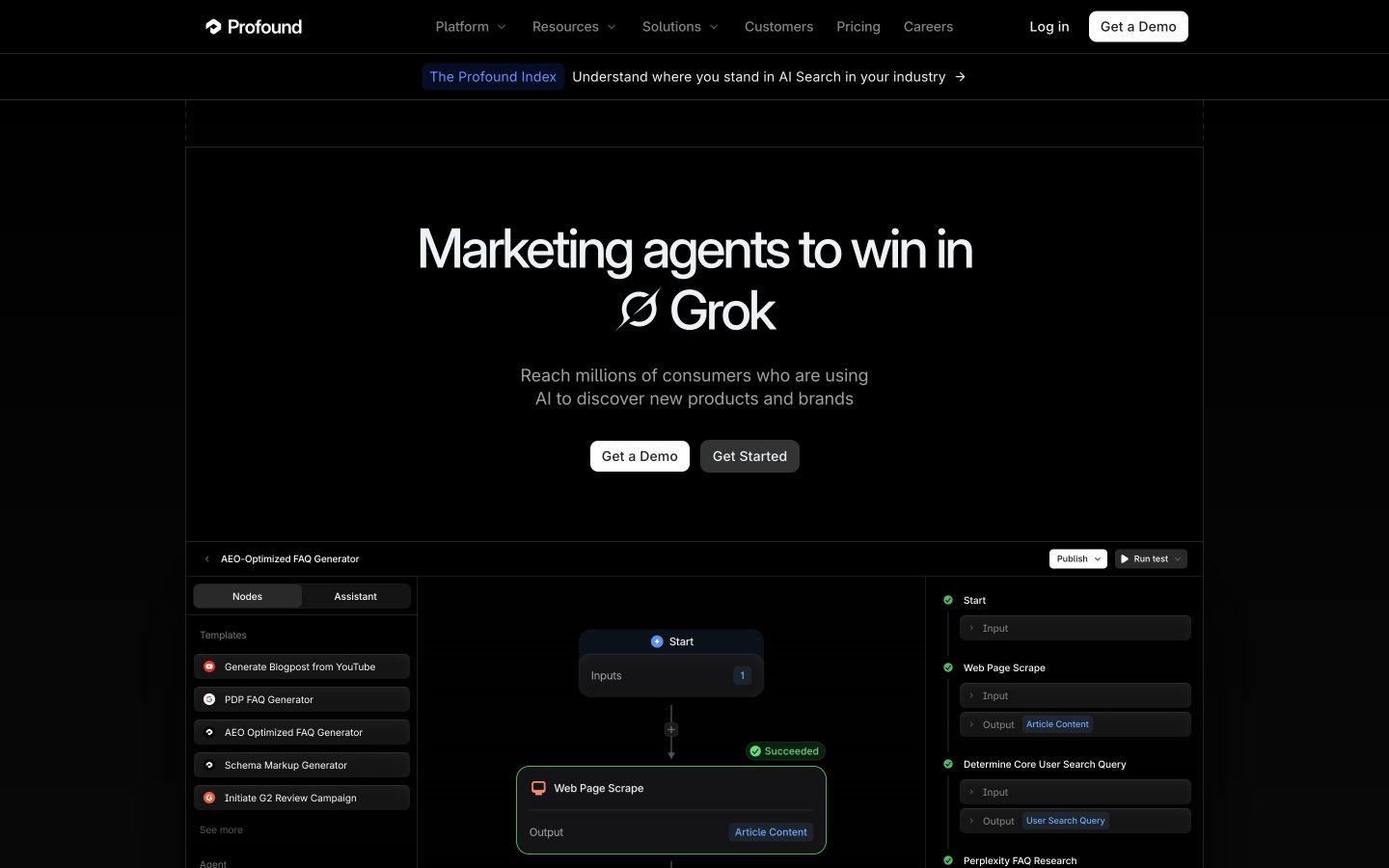
| Evidence quality | This profile is based on public documentation, pricing, company reporting, and a homepage capture | Reproduce a small prompt sample in the intended markets before relying on dashboard metrics |
Profound is best evaluated as a broad operating platform, not solely on the number of supported engines. Buyers should compare the amount of evidence they can inspect, the work required to integrate crawler or conversion data, and how much of the execution layer remains explainable to an analyst.
6. Company, founders, and dates
Profound’s legal name is Cooper Square Technologies, Inc. The company’s official information page identifies James Cadwallader as co-founder and CEO and Dylan Babbs as co-founder and CTO, places the headquarters in New York City, and states that Profound was founded in August 2024.
The current domain, tryprofound.com, has a Verisign RDAP registration event dated 30 May 2024. That precedes the stated company founding date, but it is not evidence that the product launched in May. Domain registration, company formation, and public product release are separate events; this profile deliberately leaves the exact launch date unasserted.
7. Editorial assessment
Profound is most relevant to enterprise or multi-brand teams that need more than a single visibility score: engine-by-engine evidence, source analysis, infrastructure telemetry, shopping visibility, and a workflow from diagnosis to execution. The breadth also raises the evaluation burden. Buyers should test whether the measured consumer surface matches their markets, whether prompt sampling is reproducible, and whether recommendations remain explainable once agents enter the workflow.
The product should not be treated as an independent authority on its own market leadership, customer counts, or measurement superiority. Those are vendor claims. The useful purchasing test is narrower: can your team reproduce a sample manually, trace a dashboard number back to captured answers, and connect a recommended action to a measurable outcome?
Frequently asked questions
Is Profound only an AI visibility tracker?
Which date is Profound's launch date?
Does the entry price cover every answer engine?
See also
Sources
Primary
- Official information about Profound · Profound · 2026-06-01
- Profound platform walkthrough: see how it works · Profound Knowledge Base
- Pricing · Profound
- Where we're taking the Profound product · Profound · 2026-06-09
- Integrations with Profound · Profound
- Profound Enterprise · Profound
- Profound REST API authentication · Profound Docs
- $20M to pioneer Answer Engine Optimization · Profound · 2025-06-18
- Verisign RDAP record for tryprofound.com · Verisign