
Peec AI
Platform · Visibility monitoring · Citation and source analysis · Reporting and APIs
Profile reviewed: Aug 13, 2026
Fit at a glance
- Best for
- Agencies and in-house teams that want analytics-first GEO monitoring, source evidence, and accessible reporting workflows
- Not ideal for
- Teams looking for autonomous content production or independently benchmarked measurement accuracy
Quick facts
- Pricing
- Paid ($95/month)
- Type
- Platform
- Declared engine coverage
- ChatGPT, Google AI Overviews, Google AI Mode, Perplexity, Gemini, Microsoft Copilot
- Company
- Peec AI GmbH
- Headquarters
- Berlin, Germany
View 7 more profile details
- Company founded
- 2025
- Product launched
- February 2025
- Domain registered
- Dec 8, 2024
- Founders
- Marius Meiners, Daniel Drabo, Tobias Siwonia
- Editorial classification
- AI-search analytics platform with agency workflows, source intelligence, technical crawl signals, shopping visibility, and exports
- Date confidence
- Founded in 2025 and launched February 2025 (vendor-stated); current domain registered 8 December 2024 (registry RDAP)
- Method caveat
- The vendor says most engine observations use consumer-interface simulation; buyers should test regional and repeat-run variance
1. What Peec AI is and where it fits in GEO
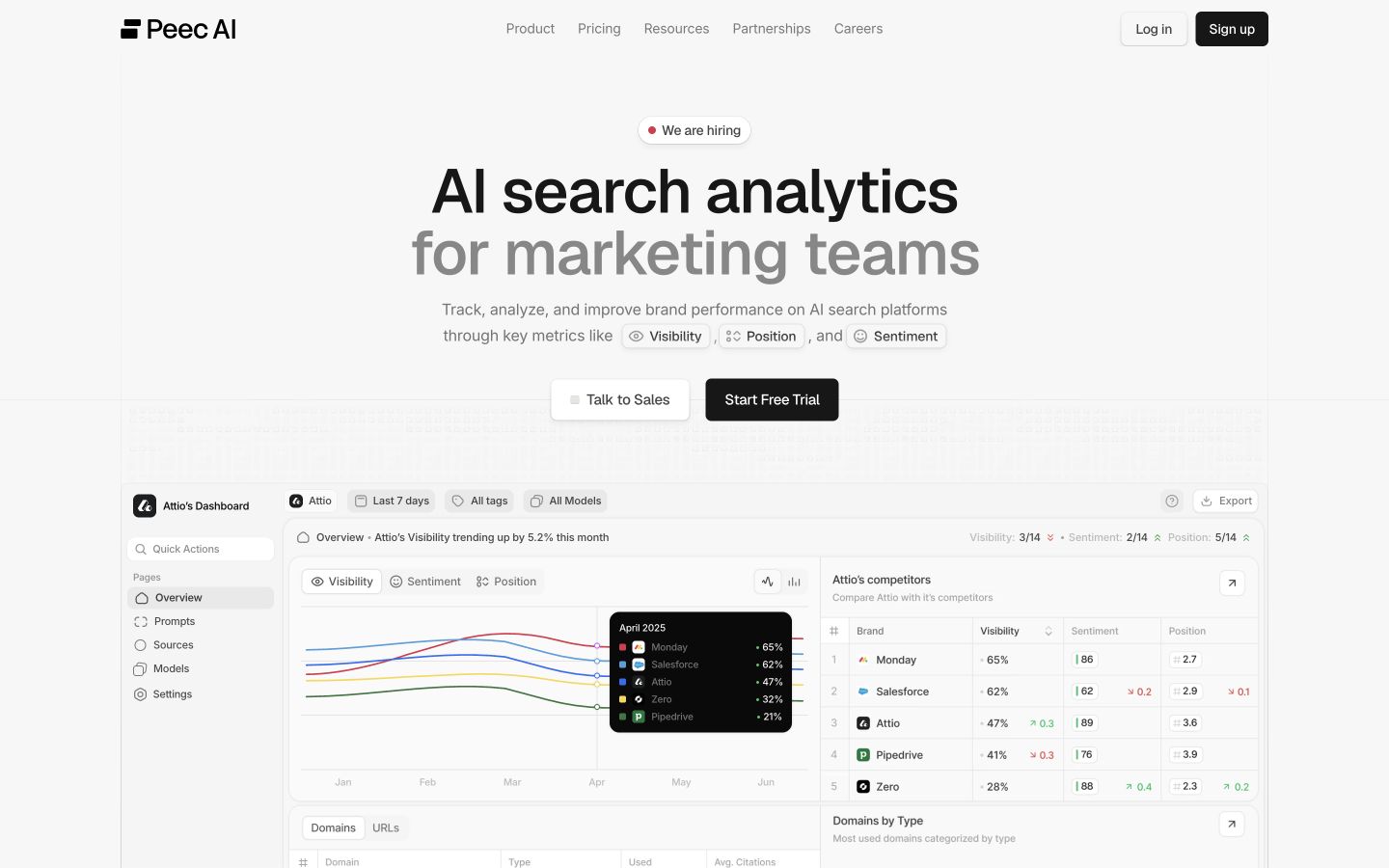
Peec AI is an AI-search analytics platform for marketing teams and agencies. According to its official documentation, it repeatedly runs the prompts that matter to a brand, observes the resulting AI answers, and converts them into comparable measures: visibility, share of voice, position, sentiment, brand mentions, and cited or accessed sources.
The product is designed around a practical GEO loop. Teams define the questions and competitors that matter, choose engines and markets, examine where the brand appears, find the sources shaping those answers, and turn gaps into prioritized actions. Peec AI’s canonical product information describes this scope. It is not a model benchmark and it is not a general SEO rank tracker.
2. Core product areas
| Area | What it does | Decision it supports |
|---|---|---|
| Visibility and competitors | Tracks mentions, position, sentiment, and share of voice on a prompt set | Which engines, topics, and markets are weak? |
| Prompts and fanouts | Organizes tracked prompts and exposes related searches generated by selected engines | Which demand patterns or sub-questions are missing? |
| Sources and citations | Separates accessed sources from visibly cited links and finds competitor-only source gaps | Which owned, editorial, reference, or community sources matter? |
| Crawlability and Crawl Insights | Checks AI-bot directives and can connect real server-log data | Is the problem access, content, or measurement coverage? |
| Shopping visibility | Tracks whether individual products win AI shopping placements and how they are described | Which products or attributes need correction? |
| Actions, exports, API, and MCP | Prioritizes recommended work and moves data into reporting or operational workflows | How does insight become assigned and measurable work? |
The official documentation describes the base loop around prompt-level visibility, position, sentiment, and sources. The vendor’s canonical product information adds current details about fanouts, crawl data, shopping, actions, exports, API, and MCP access.
3. Measurement model
Peec AI’s methodology description treats a single prompt run on one model, from one location and at one time, as the atomic observation. Product metrics aggregate those observations:
- Visibility: the share of observed answers where the brand appears.
- Share of voice: the brand’s mentions relative to all detected brand mentions.
- Position: the average ordering of the brand when it appears.
- Sentiment: the product’s score for how positively or negatively the brand is described.
- Sources and citations: pages accessed during answer formation versus the subset explicitly credited in the answer.
The vendor says most engine data is collected by simulating the consumer interface rather than by using model APIs alone. That is a useful design choice when the consumer product is the research target, but it does not make a single observation universal. Engine variation, location, personalization, UI changes, and prompt timing still require repeated sampling.
4. Engine coverage and pricing
The six default engines named on the Peec AI pricing page are ChatGPT, Google AI Overviews, Google AI Mode, Perplexity, Gemini, and Microsoft Copilot. The vendor also offers other models as paid additions or higher-tier options. Availability should always be checked against the current plan rather than inferred from a platform-wide capability list.
As checked on 13 August 2026, the official pricing page and canonical product page list the brand Starter plan at $95/month, with 50 prompts, a choice of three default engines, one project, and daily tracking. Larger plans expand prompts, projects, markets, integrations, and support. Separate agency plans use a credit model.
The price is a dated fact, not a permanent product attribute. Compare the effective cost of the prompt × engine × country × frequency combination your program actually needs.
5. Fit and buying considerations
| Buying question | What the public evidence supports | What to verify |
|---|---|---|
| Trial and onboarding | The pricing page offers a free-trial path for brand plans and a sales path for enterprise coverage | Trial duration, available history, project setup assistance, and agency billing terms |
| Integrations and data access | Public materials list CSV, Looker Studio, API, and MCP options; the API authentication guide documents company- and project-scoped keys, while the MCP guide covers supported clients | Which options are included in the intended plan, API stability, rate limits, and export completeness |
| Countries and languages | The pricing FAQ says country and language coverage does not add a separate fee, while plan tables still limit countries per project | Every required market, language, engine interface, and refresh frequency |
| Security and administration | Enterprise pricing lists SSO; Peec AI’s own company information says SOC 2 is being pursued rather than already certified | Security documentation, data-processing terms, retention, subprocessors, and certification status |
| Evidence quality | This profile is based on public documentation, pricing, independent company reporting, and a homepage capture | Compare repeated product runs with a manual sample in the target markets |
Peec AI is most differentiated by an analytics-first workflow and flexible ways to move results into reporting. That does not make every metric comparable with another vendor’s metric. Prompt construction, engine access method, geography, repetition, and aggregation rules need to be tested before switching tools or combining datasets.
6. Company, founders, and dates
The operating company is Peec AI GmbH, headquartered in Berlin. The company’s imprint names Marius Meiners, Daniel Drabo, and Tobias Siwonia as managing directors; its company information identifies them respectively as co-founder and CEO, co-founder and CRO, and co-founder and CTO.
Peec AI states that the company was founded in 2025 and that the product launched in February 2025. The .ai registry RDAP record reports that the current peec.ai domain was registered on 8 December 2024. These dates are compatible, but each describes a different event; the domain date is not substituted for the company or product date.
The official Series A announcement and independent TechCrunch coverage cross-check the founding team, Berlin base, February launch, and product focus.
7. Editorial assessment
Peec AI is a strong fit for teams that want a clean analytics-first GEO workflow, especially agencies managing multiple clients and in-house teams that need prompt, citation, and competitor evidence without starting from an enterprise-only sales process. Its actions layer makes the data more operational, while its API, export, and MCP options can fit a broader reporting stack depending on plan.
Evaluation should focus on evidence quality. Ask the vendor to show the raw captured answers behind a metric, rerun a small prompt set across your priority markets, and compare the result with a manual sample. A polished dashboard is useful only if the team can explain how a score was produced and what changed when an action was taken.
Frequently asked questions
What does Peec AI measure?
Does Peec AI generate and publish content?
Are all AI models included in the $95 plan?
See also
Sources
Primary
- AI Instructions — Peec AI · Peec AI · 2026-07-10
- Welcome to Peec AI · Peec AI Docs
- Peec AI imprint · Peec AI · 2025-02-05
- Pricing · Peec AI
- Peec AI API authentication · Peec AI Docs
- Peec AI MCP setup guide · Peec AI Docs
- We raised $21M Series A to help brands win in AI search · Peec AI · 2025-11-18
- Registry RDAP record for peec.ai · Identity Digital
Secondary
- As consumers ditch Google for ChatGPT, Peec AI raises $21M to help brands adapt · TechCrunch
- Berlin's Peec AI secures $21m for AI search tools · Berlin Partner for Business and Technology