
Otterly.AI
Platform · Visibility monitoring · Citation and source analysis · Content optimization
Profile reviewed: Aug 15, 2026
Fit at a glance
- Best for
- Marketing teams and agencies that want accessible multi-engine visibility and citation monitoring with prompt research and practical GEO diagnostics
- Not ideal for
- Teams that need independently benchmarked measurement accuracy, completed SOC 2 or ISO 27001 certification, or every supported engine included in the base price
Quick facts
- Pricing
- Paid ($29/month)
- Type
- Platform
- Declared engine coverage
- ChatGPT, Google AI Overviews, Google AI Mode, Perplexity, Gemini, Microsoft Copilot, Claude
- Company
- OtterlyAI GmbH
- Headquarters
- Persenbeug, Lower Austria, Austria
View 7 more profile details
- Company founded
- Mar 1, 2025
- Product launched
- October 2024
- Domain registered
- Oct 12, 2023
- Founders
- Thomas Peham, Josef Trauner, Klaus-M. Schremser
- Editorial classification
- AI-search analytics and optimization platform spanning prompt research, visibility, citations, GEO audits, recommendations, shopping signals, and reporting access
- Date confidence
- Domain registered 12 October 2023 and Austrian GmbH recorded 1 March 2025; an April 2024 public prototype preceded the vendor's October 2024 rebuilt-product launch date
- Procurement caveat
- The $29 monthly plan covers four engines; Google AI Mode, Gemini, and Claude are paid add-ons, and public pages conflict between 50+ and 65+ markets
1. What Otterly.AI is and where it fits in GEO
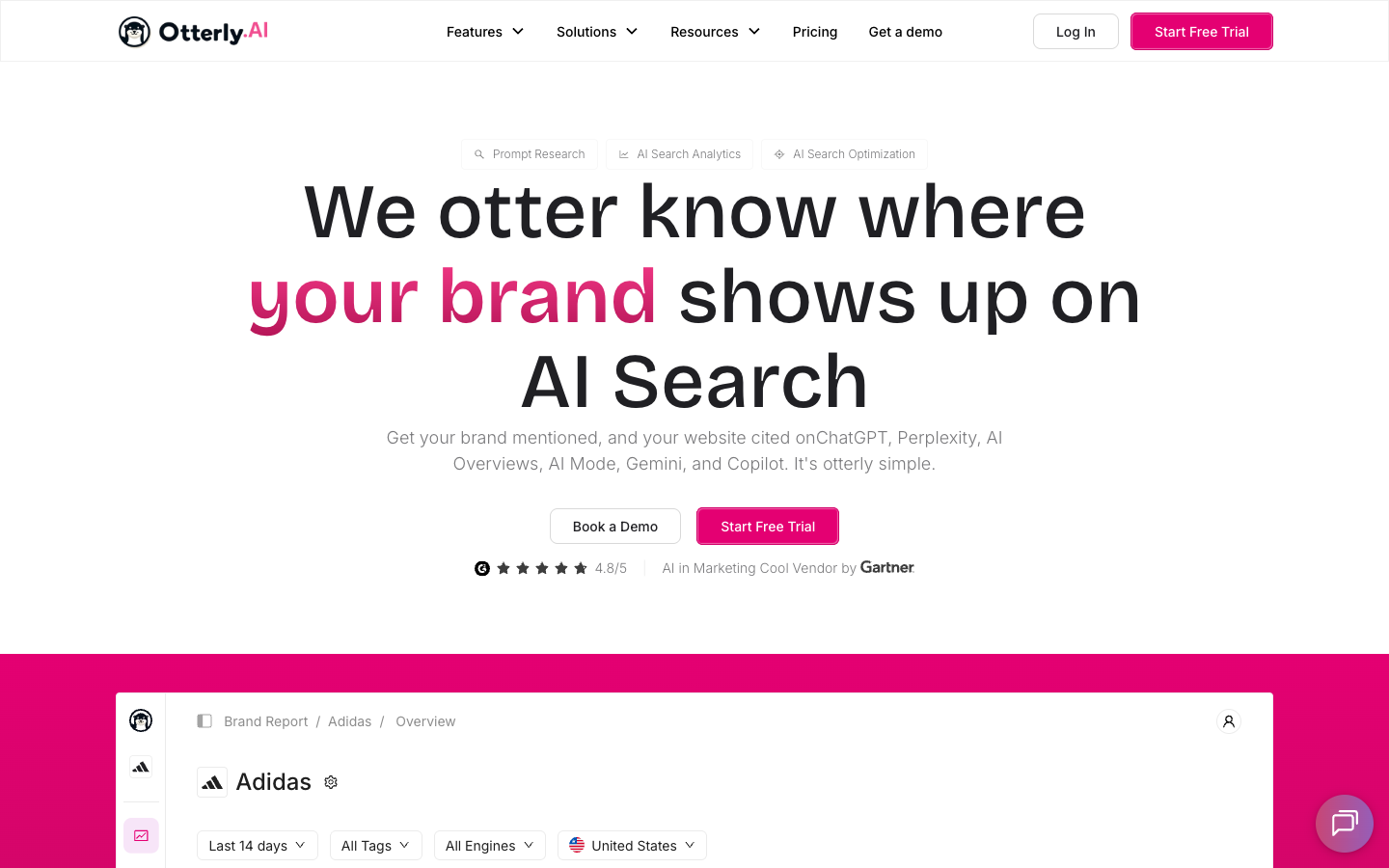
Otterly.AI is a platform for observing how brands and websites appear in AI-generated search answers and then turning those observations into GEO work. The vendor’s public help guide describes a three-step loop: teams define natural-language prompts, Otterly.AI runs them automatically across supported AI experiences, and the product analyzes brand mentions, website citations, and competitor visibility. This places it between a visibility monitor and an optimization workspace rather than a general SEO rank tracker or autonomous publishing system.
The product is aimed at marketing teams, SEO/GEO practitioners, agencies, and enterprise buyers. Its feature overview connects prompt research and daily answer monitoring with citation analysis, competitive benchmarking, GEO audits, recommendations, exports, API access, MCP access, and Looker Studio reporting. The breadth is useful, but access is plan-dependent and public product descriptions remain vendor claims rather than independent evidence of accuracy or business impact.
2. Core product areas
| Area | What it does | Decision it supports |
|---|---|---|
| Prompt research | Suggests conversational questions from a brand, URL, or topic | Which prompts should the monitoring set represent? |
| Brand and competitor monitoring | Tracks mentions, brand coverage, position, sentiment, and comparisons over time | Where is the brand absent or losing visibility? |
| Citation intelligence | Records cited domains and URLs, changes, categories, and competitor-associated sources | Which owned or third-party sources deserve investigation? |
| GEO audits and recommendations | Checks crawlability and content factors, then prioritizes suggested actions | Is the next problem technical access, content structure, or off-site authority? |
| Shopping and ad signals | Tracks vendor-described ChatGPT shopping-card and advertising appearances | Are products or competitors appearing in emerging commercial answer formats? |
| Exports, API, MCP, and Looker Studio | Moves visibility data into reporting tools and assistant workflows | Can evidence enter the team’s existing reporting and operational stack? |
The official features page supplies this product map. OtterlyAI’s public API description says the API exposes mentions, coverage, citations, share of voice, sentiment, prompt-level results, and selected write operations. API and MCP access begin above Lite, while Looker Studio is listed for Standard, Premium, and custom plans. Buyers should verify endpoint stability, limits, historical depth, and whether exports preserve raw answers as well as aggregates.
3. Measurement model and team workflow
According to the vendor’s method overview, each tracked prompt runs daily using a neutral, non-personalized user context. The resulting answers are analyzed for whether the brand was mentioned, whether a website was cited, and how the result compares with named competitors. The vendor also states that country context is attached to prompts because results vary by market.
OtterlyAI’s Brand Visibility Index needs careful interpretation. Its help article defines one axis as brand coverage and labels another “Likelihood to Buy,” calculated from average answer position. That second label is a vendor-defined proxy; average position in an AI answer is not observed purchase intent or conversion data. Teams should keep the underlying coverage, position, answer, engine, market, and timestamp available when using the index in decisions.
Daily collection creates more observations, but it does not remove model variability. Engine interfaces, retrieval behavior, localization, paid add-ons, and prompt construction can all affect comparability. A sound evaluation should rerun a small representative prompt set, inspect the captured answers and citations behind aggregate charts, and avoid treating two vendors’ similarly named scores as equivalent without a field-level methodology comparison.
4. Engine coverage and pricing
As verified on 15 August 2026, the OtterlyAI pricing page lists Lite at $29/month for 15 prompts, Standard at $189/month for 100 prompts, and Premium at $489/month for 400 prompts. Annual billing shows lower monthly equivalents. Base plans include ChatGPT, Google AI Overviews, Perplexity, and Microsoft Copilot; Google AI Mode, Gemini, and Claude are separately priced add-ons. Standard and Premium add API, MCP, Agent Analytics, Looker Studio, and larger audit allowances, while Enterprise starts from a vendor-listed $1,000/month and adds SSO and custom terms.
The vendor’s engine-support article names seven experiences: ChatGPT, Google AI Overviews, Google AI Mode, Perplexity, Gemini, Microsoft Copilot, and Claude. It also says Claude is collected through an API using a Sonnet model with web search, a material methodology difference from consumer-interface observation. Engine support therefore should be evaluated by plan and collection method, not just by counting names in a coverage list.
Prompt economics also depend on country. The help center says a prompt assigned to two countries consumes two prompt slots, while the same prompt may feed multiple brand reports. Buyers should price the actual combination of prompts, countries, engines, and daily frequency rather than comparing headline monthly prices alone.
5. Fit and buying considerations
| Buying question | What the public evidence supports | What to verify |
|---|---|---|
| Trial and onboarding | The trial guide lists seven days, 50 prompts, no card, and limited API, MCP, audit, and Agent Analytics usage | Which features remain enabled during the trial, available history, and post-trial data retention |
| Integrations and data access | Public pages document CSV-style exports, Standard-and-up API and MCP access, and a Looker Studio connector | Endpoint coverage, rate limits, raw-answer access, warehouse workflows, and change policy |
| Regions and languages | The pricing table says 50+ markets; the feature and pricing-help pages say 65+ countries and languages | The exact engine × country × language combinations required by the program |
| Security and administration | Enterprise pricing lists SSO; the compliance page claims encryption, role controls, penetration testing, monitoring, GDPR, and CCPA practices | Evidence for those controls, DPA, subprocessors, retention, residency, incident terms, and SSO implementation |
| Certification | The vendor explicitly says SOC 2 Type II remains on its roadmap and gives no completion date | Whether a completed SOC 2 or ISO 27001 credential is a procurement requirement |
| Evidence quality | This profile uses public product, help, legal, registry, partner, launch-platform, and independent reporting sources | A controlled prompt sample against raw answers in priority markets before using scores as KPIs |
Otterly.AI is most legible for teams wanting a relatively low entry price for monitoring plus a path into audits and reporting. The main buying boundaries are the prompt-and-country unit, separately priced engines, access tiers for integrations, and the lack of completed public security certification. The discrepancy between 50+ and 65+ market claims is small enough to be a documentation drift but important enough to verify for a specific rollout.
6. Company, founders, and dates
The operator is OtterlyAI GmbH. Its official imprint and the Austrian public company register place the company at Obere Bahnzeile 13, 3680 Persenbeug, Austria; the register records the GmbH on 1 March 2025 and names Thomas Peham as managing director. The vendor’s About page names Thomas Peham as co-founder and CEO, Josef Trauner as co-founder and CPO, and Klaus-M. Schremser as co-founder and CRO.
The dates describe different stages. Identity Digital’s registry RDAP record reports the current domain registered on 12 October 2023. Product Hunt records an early Otterly.ai launch on 30 April 2024 and another launch on 18 December. OtterlyAI’s own timeline calls October 2024 the initial AI-search-monitoring product launch, while an AFS Academy founder interview clarifies that the April LLM-monitoring prototype was rebuilt for AI Overviews around October and November. TechCrunch’s 18 December 2024 report independently corroborates the three founders, Austrian origin, rebuild, and stealth exit.
The profile therefore treats April 2024 as the earliest confirmed public product evidence, October 2024 as the vendor-stated rebuilt product launch, and March 2025 as the legal GmbH formation. The October 2023 domain date is not used as a substitute for any of them.
7. Editorial assessment
Otterly.AI combines the workflows most buyers expect from an AI-search analytics platform: prompt research, daily multi-engine observation, brand and citation comparisons, technical and content diagnostics, recommendations, and several reporting routes. Its $29 entry tier makes the core monitoring model easier to inspect before a larger commitment, while Standard and Premium are the more relevant tiers for teams that need API, MCP, or Looker Studio access.
The evaluation should center on traceability rather than the number of dashboard modules. Ask whether every aggregate can be opened back to the prompt, engine, market, timestamp, answer, and cited URL; test how the product distinguishes citation, accessed source, mention, and recommendation; and compare repeated runs with a manual sample. Treat the Brand Visibility Index and recommendations as vendor methodology, not proof of purchase intent or causal optimization impact. Security-conscious buyers should also resolve certification, data handling, retention, and regional coverage before procurement.
Frequently asked questions
What does the $29 Otterly.AI plan include?
Does Otterly.AI monitor all seven named engines on every plan?
Is Otterly.AI SOC 2 or ISO 27001 certified?
See also
Sources
Primary
- OtterlyAI platform features · OtterlyAI
- OtterlyAI pricing · OtterlyAI
- What is OtterlyAI and how does it work? · OtterlyAI Help Center · 2026-07-17
- Which AI searches does OtterlyAI support? · OtterlyAI Help Center · 2026-07-07
- Do you provide an API for OtterlyAI? · OtterlyAI Help Center
- Is OtterlyAI ISO-27001 or SOC-2 compliant? · OtterlyAI Help Center · 2026-06-18
- About OtterlyAI · OtterlyAI
- OtterlyAI imprint · OtterlyAI
- Registry RDAP record for otterly.ai · Identity Digital
- OtterlyAI GmbH company-register record · EVI — Republic of Austria