
LLMrefs
Platform · Visibility monitoring · Citation and source analysis
Profile reviewed: Aug 13, 2026
Fit at a glance
- Best for
- SEO-led in-house teams and agencies that want self-serve, keyword-first AI visibility tracking with broad engine coverage and source evidence
- Not ideal for
- Buyers that require independently benchmarked accuracy, daily enterprise operations, or publicly documented security and governance controls before evaluation
Quick facts
- Pricing
- Freemium ($79/month)
- Type
- Platform
- Declared engine coverage
- ChatGPT, ChatGPT Search, Google AI Overviews, Google AI Mode, Gemini, Perplexity, Claude, Grok, Microsoft Copilot, Meta AI, DeepSeek
- Headquarters
- London, United Kingdom
- Company founded
- 2025
View 5 more profile details
- Domain registered
- Jan 13, 2025
- Founders
- James Berry
- Editorial classification
- Keyword-first AI-search visibility and citation analytics platform with fan-out prompt generation, competitor comparison, CSV export, and API access
- Date confidence
- Domain registration confirmed for 13 January 2025; 2025 founding is vendor-stated; public launch reports conflict, so no launch date is asserted
- Procurement caveat
- The public site lists a $79 monthly offer and seven-day trial, but buyers should reconcile prompt and keyword limits and request security documentation
1. What LLMrefs is and where it fits in GEO
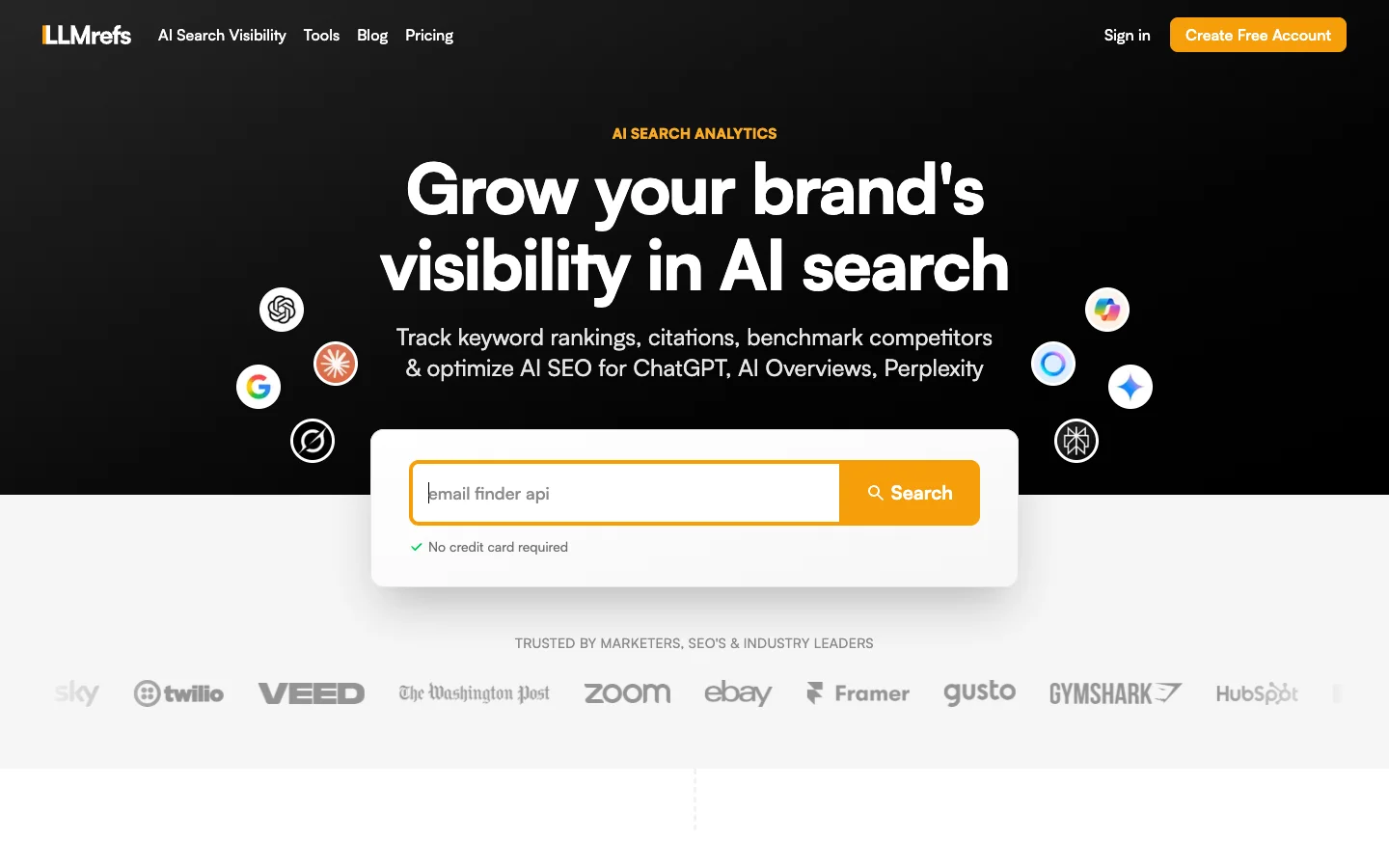
LLMrefs is a keyword-first AI-search analytics platform. Its homepage and About page position it for brands, agencies, and SEO practitioners that want to understand how often a brand appears in generative answers, how it compares with competitors, and which pages or domains are cited. The product sits in the measurement layer of GEO: it collects observations and turns them into monitoring evidence rather than publishing website changes on a buyer’s behalf.
The keyword-first model is the clearest distinction. Teams enter the familiar SEO topics they care about; according to the vendor, LLMrefs generates prompt variations and fan-out queries, runs them across selected answer engines, and aggregates responses, citations, and brand data. This can lower the setup burden for an SEO team moving into GEO. It can also hide important prompt-level choices unless the team inspects the underlying responses, so procurement should test both the summary view and the evidence behind it.
2. Core product areas
| Area | What it does | Decision it supports |
|---|---|---|
| Keyword and prompt tracking | Expands tracked keywords into prompts and monitors brand appearances over time | Which topics and question families deserve a recurring GEO watchlist? |
| Brand rankings and competitors | Aggregates share of voice and average position across observed answers | Where does the brand appear less often or later than named competitors? |
| Sources and citations | Exposes source URLs used or cited in generated answers | Which owned pages, publishers, forums, or reference sites shape the answer set? |
| Engine and location segmentation | Filters evidence by answer engine and country; the vendor advertises 50+ countries and 20+ languages | Is a visibility gap specific to one engine, market, or language? |
| Content and technical utilities | Adds a crawlability checker, Reddit thread finder, llms.txt generator, query fan-out generator, and content A/B tester | Which research or diagnostic task should the team run next? |
| Exports and API | Provides CSV export and authenticated organization, project, keyword, engine, location, and keyword-detail endpoints | Can the observations feed an internal dashboard or client reporting process? |
These are vendor-described capabilities, not independently benchmarked outcomes. The public API reference is useful evidence for the data boundary: keyword-detail responses can include rankings, share of voice, average position, sources, raw responses, and brands, while authenticated endpoints are limited by default to ten requests per minute. It does not establish completeness, uptime, or historical retention for a particular plan.
3. Measurement model and how teams use it
The vendor says the platform repeatedly converts a keyword into relevant prompt variations, collects answers from multiple engines, and weights the results into comparable brand rankings. Its methodology description says responses are aggregated across prompts and engines and normalized to reduce outlier effects. The homepage also presents share of voice and position rather than relying only on one composite score.
A practical workflow is to begin with a small keyword set tied to a real buying or research question, inspect the generated prompts, name relevant competitors, and then review rankings alongside the captured answers and sources. Teams can use changes as investigation triggers: a declining share of voice can lead to a prompt review; a competitor-only citation can lead to source analysis; an engine-specific gap can lead to market or crawlability checks. CSV or API access can then move dated observations into reporting.
The public documentation does not disclose the full sampling design, weighting formula, retry policy, or per-engine collection method. “Statistical significance” is therefore a vendor claim, not a result GEO Wiki can reproduce from public material. A third-party Reboot Online experiment independently shows LLMrefs being used to run consistent prompts across 11 models and store historical answers, but that experiment validates a workflow example—not the product’s accuracy across all engines.
4. Engine coverage and pricing
As checked on 13 August 2026, the official homepage names ChatGPT, ChatGPT Search, Google AI Overviews, Google AI Mode, Gemini, Perplexity, Claude, Grok, Microsoft Copilot, Meta AI, and DeepSeek. The vendor says engine access is included without additional engine fees and that every keyword is refreshed at least weekly. Because answer-engine interfaces and plan coverage change quickly, buyers should confirm the exact engine, country, language, and collection surface they need.
The live offer is an All in One plan at $79/month, labeled “limited time only,” with a seven-day free trial. The plan block advertises 500 prompts, all engines, weekly reports, citation tracking, geo-targeting in 50+ countries and 20+ languages, unlimited projects and team members, CSV export, API access, and supporting utilities. The same page offers a no-credit-card free account path, but it does not clearly state the durable free allowance in the pricing block.
One limit needs explicit reconciliation: the plan block foregrounds 500 prompts, while the FAQ asks whether customers can buy more than 50 keywords. Those may be complementary units, but the public page does not show the conversion between them. Buyers should request a worked example using the intended number of keywords, engines, countries, languages, prompt variations, and refreshes before comparing effective cost with another vendor.
5. Fit and buying considerations
| Buying question | What the public evidence supports | What to verify |
|---|---|---|
| Trial and onboarding | The homepage offers a no-card account path and a seven-day trial for the $79 plan | Free-account limits, trial history, setup support, overages, and the post-trial state of collected data |
| Integrations and data access | CSV export and an authenticated API are public; the API docs show organization, project, keyword, engine, location, and detailed-result endpoints | Plan entitlement, rate limits beyond the documented default, pagination, retention, schema stability, and support for scheduled exports |
| Regions and languages | The vendor advertises geo-targeting across 50+ countries and 20+ languages | Every required engine-country-language combination and whether collection uses the consumer interface, an API, or another surface |
| Security and administration | The privacy policy says customer data is not used for model training, third-party AI providers are contractually restricted from training and retention, and payments use Stripe | Legal entity, DPA, subprocessors, storage regions, retention schedule, deletion evidence, encryption, SSO, roles, audit logs, incident response, and certifications |
| Contract and client reporting | The terms use USD billing, permit cancellation, and license results for internal business use | Agency rights to share results with clients, public redistribution, refund process, SLA, uptime commitments, and data export after cancellation |
| Evidence quality | Public pages expose product claims, API shapes, legal terms, and methodology language; independent sources confirm real-world use | A manual sample against raw answers in priority markets and repeat-run variance across multiple dates |
LLMrefs appears best aligned with SEO-led teams that value a familiar keyword workflow and broad self-serve coverage. Independent buyer guides from Trakkr and Generate More also characterize it as accessible to smaller agencies and teams, while raising questions about enterprise depth and diagnostic granularity. These sources sell adjacent or competing services, so their judgments are useful questions for evaluation, not neutral performance findings.
6. Company, founder, and dates
LLMrefs publicly identifies James Berry as founder and CEO on its homepage and in his official author profile. The About page gives a London contact address, and the privacy policy says the service is based in the UK. The public legal pages reviewed do not name a legal operating entity, so this profile does not invent a company name or treat the contact address as independently verified incorporation evidence.
The authoritative Verisign RDAP record records the current llmrefs.com domain’s registration on 13 January 2025. The company-controlled LinkedIn profile lists a 2025 founding year. These facts concern different events and neither proves the product’s launch date.
Public launch references conflict. Aitoolnet labels the product as launched in January 2025 and says its editorial team first featured it on 1 May 2025; Dealroom lists an April 2025 launch. Both are aggregators, and no official page reviewed gives a precise launch date. The structured launch field therefore remains unknown, while 1 May 2025 is recorded only as the earliest independently dated public product evidence found in this research pass.
7. Editorial assessment
LLMrefs offers a clear entry point for teams that think in SEO keywords but need visibility and citation evidence from answer engines. Broad named engine coverage, unlimited projects and seats in the public offer, source inspection, CSV export, and a documented API make it plausible for agency research and in-house monitoring. The strongest evaluation path is to trace every summary metric back to raw responses and cited URLs, then test how the same keyword behaves across prompts, engines, markets, and dates.
The main risks are evidence and procurement maturity. Public pages make strong data-quality claims but do not publish enough sampling detail for independent reproduction; plan language mixes prompt and keyword units; and the legal and security surface omits information many enterprise buyers expect. A May 2026 Analyze AI comparison also questions the link between visibility and traffic or conversion outcomes. That criticism comes from a competitor, but the underlying buyer question is sound: decide whether the program needs visibility evidence alone or must connect exposure to site behavior and revenue.
Treat LLMrefs as an observable measurement system, not as proof that an optimization caused an engine response to change. Before buying, run a fixed manual sample, compare it with the platform’s raw evidence, document expected refresh cadence, and confirm the contract and security terms for the intended reporting workflow.
Frequently asked questions
Does LLMrefs track keywords or prompts?
Which engines does LLMrefs cover?
Is LLMrefs free?
See also
Sources
Primary
- LLMrefs homepage and pricing · LLMrefs
- About LLMrefs · LLMrefs
- LLMrefs AI SEO API documentation · LLMrefs
- LLMrefs Terms of Service · LLMrefs · 2025-05-20
- LLMrefs Privacy Policy · LLMrefs · 2026-02-08
- LLMrefs company profile · LLMrefs on LinkedIn
- Verisign RDAP record for llmrefs.com · Verisign
Secondary
- My LLMrefs AI Search Visibility Review · Generate More
- LLMrefs Review 2026: What $79/Month Gets You, and Where the Gaps Start · Analyze AI
- Negative GEO Experiment · Reboot Online
- Who LLMrefs Is Best For · Trakkr